
HONG KONG – In a post-Apple-mixed-reality-glasses era, the spotlight is fixed firmly on the capabilities and potential of microdisplay technologies. While the allure of Apple’s Micro-OLED displays is undeniable, they aren’t without their shortcomings – notably their expense, limited brightness, and durability concerns.
Step into the limelight, Rayleigh Vision.
Founded in 2023, Rayleigh Vision’s origins may be recent, but their impact in the realm of Micro-LED technology is undeniable. Spearheaded by the venerable Professor Jr-Hau HE and industry expert Dr. Eddy Hsu, the company is redefining how we perceive displays. They’ve successfully developed a dual-layer Micro-LED which leverages an advanced stacking technology, allowing each layer to independently fine-tune colors. The result? Displays that promise to be clearer, brighter, and more vibrant than anything seen before, positioning them as leaders for the next generation of consumer electronics.
While headquartered in Hong Kong, their influence spans the globe with presence in California and Taiwan. Rayleigh Vision’s product range, particularly the 0.55” full-color Micro-LED microdisplay and its 0.38” counterpart with a staggering pixel density of 3780 ppi, showcases the brand’s commitment to pushing technological boundaries. Their command over 2.5 μm Micro-LED pixels, achieving pixel densities north of 10,000 ppi, adds another
feather to their already illustrious cap.
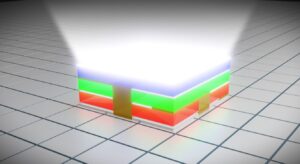
But innovation isn’t without its hurdles. As Dr. He insightfully points out, Micro-LED technology, despite its boundless potential, grapples with various challenges. From heat management and precise alignments to rethinking the fundamental tech stack, the journey is intricate. Yet, Rayleigh Vision stands resilient. Their patented solutions are not mere incremental updates but pivotal leaps that simplify the mass production of Micro-LED, ensuring both quality and affordability.
The tech giants of the world are certainly taking notes. Rayleigh Vision’s potentials to mass-produce Micro-LED technology, especially for larger wafers, has caused a stir amongst electronic conglomerates.
Rumors abound that Apple is keen on boarding the Micro-LED train, with predictions from insiders like Dr. Hao-Chung Kuo suggesting an Apple Watch featuring Micro-LED displays by 2026, soon to be followed by their mixed-reality eyewear. The reason is straightforward: Micro-LEDs offer unparalleled visual clarity and realism, far outpacing contemporaries like
LED, Mini-LED, and even Micro-OLED.
The Micro-LED market is poised for explosive growth, with valuations expected to catapult from $500 million in 2022 to an astonishing $20 billion by 2027. Investments from tech behemoths, exemplified by Google’s 2022 play, underline the technology’s prospective dominance.
Micro-LED’s ascension demands a confluence of varied expertise, spanning chip design, wafer production, and next-gen manufacturing. With a surge in research and funding, the future seems ripe for innovation.
Offering further insights, Micro-LED veteran Dr. Liu Zhaojun elucidates on the traditional strategies employed for full-color Micro-LED displays. But it’s Rayleigh Vision’s novel stacking method that truly captures his excitement. It doesn’t merely hint at innovation, it signals an industry-wide metamorphosis.
About Rayleigh Visions:
Despite its recent inception in 2023, Rayleigh Vision has emerged as a beacon in the Micro-LED arena. The company rests on a foundation of unparalleled expertise, with a team that collectively boasts an average of 15 years across various specializations. Their impressive portfolio reflects their commitment to leading-edge innovations. With breakthroughs like their stacked Micro-LED technology, they’re steering the industry towards new horizons, touching everything from AR/VR to the realm of automotive displays. Their recent flurry of 15 patent applications amplifies their vision to pioneer rather than just participate in the industry’s growth.
Rayleigh Vision isn’t just tracking the trajectory of the Micro-LED world; they’re actively shaping it.
